
Top Cashless Countries in the World
Table of Contents

Author: April Summers

Editor: Artiom Pucinskij
We only list companies that are trustworthy and appropriately licensed. Our aim is to give you a comprehensive view of the regulated money transfer marketplace.
DisclosureMoneyTransfers aims to help users find the best money transfer provider for their needs. To support our free service, we may earn a commission from some of the providers listed in our search results. The commission may also impact the ordering of the providers shown. Our reviews are independent from this and are based on our editorial policy, research and testing of dozens of remittance providers on the market.
Table of Contents
We've analyzed the data on opinions about a cashless society from 21 countries. The results show mixed feelings, with no continent fully in favor. Some countries welcome the change, while others prefer to stick with cash.
Here, we'll break down the data, and look at the challenges of moving towards a cashless society.
Worldwide research
Residents from 21 different countries around the world were surveyed on whether Britain's move towards a cashless society would be “positive” or “negative”.
The answers gave a clear idea of the countries most approving of the switch, and conversely, those that favor more traditional payment processes.
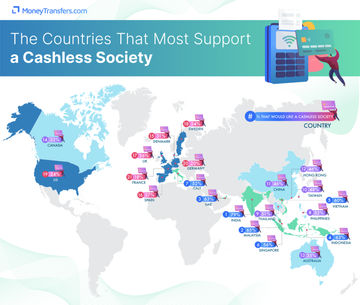
As you can see from the results, not one single continent voted overwhelmingly in favor of going cashless.
Countries analyzed in Europe, Asia, and North America are divided in their opinion; this may make the switch to a cashless society complicated.
The top 10 countries supporting a cashless society
With the cashless movement given a ‘10 year boost’, more companies and customers are starting to shun traditional cash payments.
We looked at whether this comes as a welcome change to residents of each country, or if they would miss dealing with notes and coins.
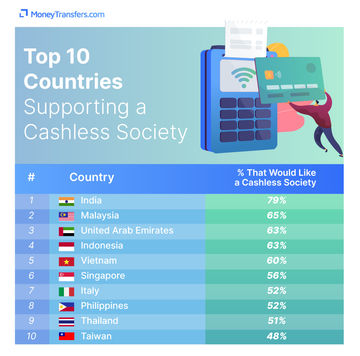
Topping the list of countries most likely to support a completely cashless society is India, with 79% of respondents showing positive feelings towards the motion.
Out of these individuals, 21% stated they would use cashless payment even on small purchases, like buying a pack of chewing gum.
Coming in second place is Malaysia as 65% of residents had confidence that cashless was the way to go.
Not far behind are the United Arab Emirates and Indonesia, where 63% of individuals surveyed were welcoming of the idea of exclusively using electronic forms of money.
Of the remaining countries in the top 10, over half of the participants in Vietnam, Singapore, Italy, the Philippines, and Thailand would opt for a credit card, mobile wallet, or another cashless method when making a very expensive purchase, such as buying a new electronic device, thus voting in favor of a cashless society.
Which countries prefer traditional currency vs. cashless?
Not every country is largely in favor of an entirely cashless society.
Many respondents in our worldwide survey stated they would only be swayed away from physical currency when making a “very expensive purchase”.
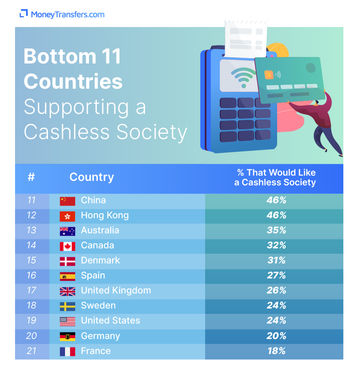
Respondents from China and Hong Kong were on the fence about going fully cashless; in both countries, just under half (46%) of respondents said they felt positive about the thought of going cashless.
Interestingly, three-quarters of those surveyed from China find it easy to access cash from a free ATM, which may explain their preference.
Positivity plummets in Australia, with only 35% of respondents welcoming a cashless society. Canada is not far behind either, with only a third (32%) of respondents preferring to ditch their coins.
Denmark, Spain, and the United Kingdom follow behind, with 31%, 27% and 26% of respondents "happy" about turning cashless, respectively.
Our analysis found that most individuals surveyed from these European countries expressed they would not use an electronic form of payment for a cheap purchase.
However, it was France at the very bottom of our list, with French natives struggling to find enthusiasm for the idea of becoming a cashless society.
Germany (20%) followed closely behind with 20% of nationals welcoming a cashless society, and the USA and Sweden after that (24%).
Benefits and drawbacks of a cashless society
Interested in finding out more about the positives and negatives cited by respondents in the YouGov study, we delved deeper to identify the pros and cons of a cashless society.
- It’s good for the environment – less resources wasted on money production
- Cash-free payments are significantly quicker, more convenient, and require zero contact
- It’s easy to keep on top of your money and track any problems or missing money
- It can boost your credit score, which is needed to qualify for loans and mortgages
- Crime will be reduced – cash is untraceable, so plays the main role in crime, less cash would result in a decline in robberies
- It’s cheaper for countries – cash infrastructure costs a lot to run (in Britain, it’s somewhere around £5 billion a year)
- There’s less interaction between individuals
- Digital finance is susceptible to IT failures and cyber-attacks
- It’s threatening the high street due to the increase in online shopping
- It can be harder to budget – it’s easy to spend and exceed your limit when making cashless transactions and become less aware of your daily outgoings
- As it’s so much easier to spend, it can encourage bad spending habits
COVID-19 impact on cash
COVID-19 has affected almost every area of our lives and the money transfer industry is no different.
Due to the emergence of coronavirus, cashless payments are the preferred payment option for businesses and individuals alike, as the act of handing over banknotes could lead to an expedited spread of the virus.
To investigate the relationship between COVID-19 and cash, we investigated the countries less likely to use physical money since the outbreak began.
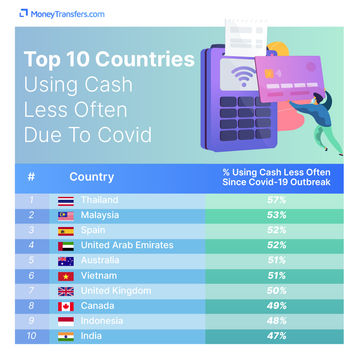
More than half of respondents in the top six countries reveal they have used less cash since the COVID-19 outbreak, with Thailand topping the list with a huge 57% of people choosing to forgo traditional payments.
Even though only 26% of those surveyed in the United Kingdom were supporting a cashless society, 50% said they have been wary of dealing with physical money since the pandemic started.
However, this could be due to the companies encouraging digital alternatives for making payments.
Although India was the most welcoming of going cashless, only 47% of survey-takers have used cash less often since the coronavirus outbreak.
However, this may be because the focus on cashless means was already solidified before the outbreak.
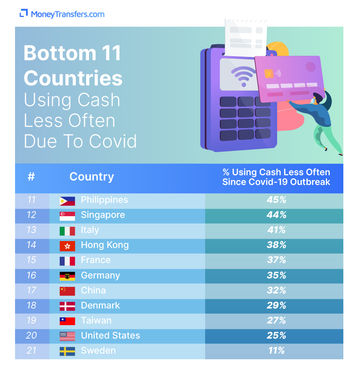
The payment methods of countries least affected by coronavirus include the Philippines, Singapore, and Italy as 45%, 44%, and 41% of respondents felt coronavirus affected the amount they use cash, respectively.
Denmark, Taiwan, and the United States are among the lowest with 29%, 27%, and 25% of people surveyed contributing a change in their payment habits to the virus.
However, it is Sweden at the bottom of the list, as only 11% of participants saw a decrease in their cash usage due to COVID-19.
But following the news that the country is already aiming to become the first cashless society, this low percentage does not look incredibly shocking.
Let's recap: Which countries are likely to support a cashless society?
In a fast-moving digital world, it seems inevitable to gravitate towards predominately digital forms of currency. By understanding the stance different countries take on this subject, we can anticipate the territories most likely to roll out cashless payments in the near future.
Socio-economic factors dictate the reasons for demonstrated desire or resistance towards the implementation of electronic forms of payment, and for obvious reasons, this differs from country to country.
MoneyTransfers is proud to conduct worldwide research and present important findings that can help better inform the outlook of diverse global economies.
Methodology
Interested in money trends, MoneyTransfers.com analyzed the latest data from YouGov to establish which countries in the world would most like a cashless society.
To achieve this, 25,823 adults from 21 different countries across the world were surveyed.
The 21 countries surveyed alongside respective sample sizes:
Canada (1,009)
India (1,010)
UK (1,734)
Germany (2,049)
France (1,011)
Denmark (1,010)
Sweden (1,007)
United States (1,198)
Italy (1,010)
Spain (1,020)
United Arab Emirates (1,000)
Australia (1,058)
China (1,023)
Hong Kong (1,023)
Indonesia (2,133)
Malaysia (1,135)
Philippines (1,102)
Singapore (1,056)
Taiwan (1,041),
Thailand (2,091)
Vietnam (1,103)
To discover which countries in the world would most like a cashless society, respondents in each respective country were asked:
“Do you think it would be a positive or negative if your country became cashless, meaning only electronic forms of money (e.g. debit cards, credit cards, Apple Pay, Google Pay, etc...) would be accepted?”
For this question, respondents could pick one answer from a choice of six possible options that included: ‘Very positive’, ‘somewhat positive’, ‘no difference’, ‘somewhat negative’, ‘very negative’, and ‘don’t know’.
To analyze results more digestible and easier, the ‘very positive’ and ‘somewhat positive’ results were grouped as a ‘net positive’ result and the ‘very negative’ and ‘somewhat negative’ results were grouped as a ‘net negative’ result.
For our analysis and review of results, the ‘net positive’ results were focused on for each respective country included in the research.
Additionally, to get a firm understanding of what impact COVID-19 has had on the use of physical cash around the world, respondents in every country were asked:
“What impact has the coronavirus pandemic had on your use of cash?”
For this question, respondents could pick one answer from a choice of five possible options that included: ‘I’ve paid in cash more often since the pandemic’, ‘I’ve paid in cashless often since the pandemic’, ‘no impact – I mostly didn’t use cash before and still don’t’, ‘no impact- I mostly used cash before and still do’ and ‘don’t know’.
Whilst not the focal aspect of the research, we looked at the response rate for the ‘I’ve paid in cashless often since the pandemic’ option in each of the respective countries for additional context and statistics.
Sources & further reading
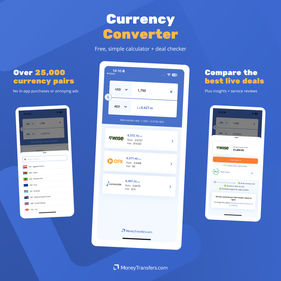
Currency Converter App by MoneyTransfers.com
The humble currency converter. One of the first apps launched onto app stores back in 2007. Many of us had one on our phone, and many still do.
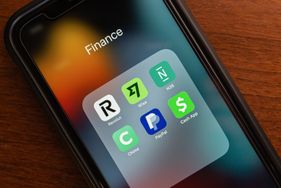
Best Money Transfer Apps
Sending money through PayPal can feel more convenient if you already have an account. It is often the go-to when considering which app to use.
Mobile Money: What Is It & What Are The Benefits?
Mobile money is a digital or electronic service you have on your smartphone or tablet, often linked to your mobile number or email address.
Guide to Making PayPal Mass Payments in 2026
This US-based online money transfer provider is one of the most popular payment platforms of all time and the company was one of the first of its kind when it launched in 1998. PayPal is now one of the leading electronic money institutions in the world, with an estimated 392 million customers as of early 2021. Customers can use their account, logging in via web or the PayPal app, to transfer and collect money, set up payments, and make in-store and online purchases.
Alternatives to Zelle
Zelle is fast, free, and easy as long as you’re sending money within the US But the moment you try to send funds internationally, well, you can’t.
Contributors

April Summers

Please share your experience with …