
How long does a SWIFT transfer take?
Table of Contents

Author: Mehdi Punjwani
We only list companies that are trustworthy and appropriately licensed. Our aim is to give you a comprehensive view of the regulated money transfer marketplace.
DisclosureMoneyTransfers aims to help users find the best money transfer provider for their needs. To support our free service, we may earn a commission from some of the providers listed in our search results. The commission may also impact the ordering of the providers shown. Our reviews are independent from this and are based on our editorial policy, research and testing of dozens of remittance providers on the market.
Table of Contents
Completing a SWIFT transfer can take 1-5 working days, making them an inefficient and expensive way to send money abroad. Our MoneyTranfers.com guide explains why they’re so time-consuming, and what faster alternatives you should consider.
Search Now & Save On Your Transfer
Instantly view live exchange rates, fees & features.
A SWIFT transfer is when you send money from your bank account to another bank account, without using a third-party provider to facilitate the payment. SWIFT, standing for Society for Worldwide Interbank Financial Telecommunication, is actually the communication method by which banks swap details about the transfer. During international bank transfers, The money itself is processed by a clearing house, as well as sometimes multiple intermediary banks.
How long does a SWIFT transfer take?
While there is no definitive answer, you’ll find most SWIFT transfers take 1-5 working days to complete. It will depend on factors like:
The banks involved: Some banks will process international money transfers faster than others, occasionally even offering fast transfers for an extra fee. Banks with existing relationships between each other tend to be able to send money faster, but this isn’t always the case.
The currencies involved: Banks and other financial institutions are generally able to handle transactions involving major currencies at greater speed, while rarer and more exotic currencies might require more time to process.
The time you start the transfer: Banks have cut off times, after which they won’t process any new transactions - while most also don’t process transfers on weekends and public holidays.
Fraud checks: Larger money transfers, often those exceeding $10,000, might trigger the attention of the IRS or other bank security. You might have to show the source of funds or prove your identity, which can hold up the transfer.
SWIFT transfer times for US banks
Here’s how long SWIFT payments can take with some of the biggest banks in the USA:
Provider | Average transfer time | Cut-off time | Transfer fee | Exchange rate markup |
|---|---|---|---|---|
Bank of America | 3-5 days | 5pm (ET) | $45 | 5-7% |
Chase Bank | 3-5 days | 4pm (ET) | $5-50 dollars | 4-7% |
PNC | 2-3 days | 10pm (ET) | $40-45 | Around 3% |
Capital One | 3-5 days | 3pm (ET) | $40-50 | 4-7% |
Schwab | 2-5 days | 2:30pm (ET) | $15-25 | Undisclosed |
How does a SWIFT transfer work?
The SWIFT network is technically a communication system used by banks to send details about an upcoming transaction before it takes place. It facilitates your international money transfer in the following way:
The sender will initiate the transaction with their bank, giving instructions to send money to the recipient’s bank
The sending bank communicates with the recipient’s bank via SWIFT, sending details including the sending account, the receiving account, and the exact value of the transfer
The money is moved separately through a clearing house, either CHIPS or Fedwire
How does a wire transfer work?
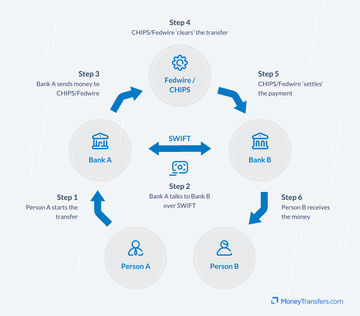
When you make a wire transfer abroad, you use the SWIFT system described above to conduct part of the process. The overall money transfer occurs in the following way:
The transfer is initiated
The sender, Person A, informs their bank that they want to send money to their chosen recipient, Person B
The banks communicate via SWIFT
As mentioned above, the sending bank communicates with the receiving bank using the SWIFT communication network
The money is sent
The sending bank transfers the money to either Fedwire or the Clearing House Interbank Payments System (CHIPS)
The transfer is cleared
The clearing house ‘clears’ the transfer by confirming transaction details
The transfer is settled
The clearing house ‘settles’ the payment by moving the money to the receiving bank
The recipient gets the money
The receiving bank credits the money into the receiving bank account
Why does a SWIFT transfer take longer than other methods?
SWIFT payments can take a few days to complete due to the complicated nature of the international banking system - but the main factor slowing them down is the potential chain of intermediary banks involved.
Intermediary banks
When sending money to a foreign bank account, if your bank doesn’t have an existing relationship with the receiving bank, the SWIFT communication is sent through corresponding banks.
Each processes the transaction message, adding time to the transaction, and often each bank will also take a fee - increasing the overall cost of your international bank transfer.
Security checks
Additionally, SWIFT money transfers are subject to stringent fraud and security checks, and the level of scrutiny can vary between banks and location. For example, know-your-customer (KYC) and anti-money laundering (AML) checks are not the same in every state and region.
What are SWIFT codes?
SWIFT codes are used to identify the specific bank you want to send money to. Usually made of 8 or 11 characters, it contains codes that reference the destination country, bank location, and branch number.
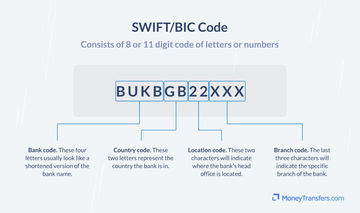
SWIFT codes all follow the same format, arranged accordingly: AAAABBCCDDD.
AAAA: Bank code. These 4 letters usually look like a shortened version of the bank name.
BB: Country code. These two letters represent the country the bank is in.
CC: Location code. These two characters will indicate where the bank’s head office is located.
DDD: Branch code. The last three characters will indicate the specific branch of the bank.
Where do I find a SWIFT code?
Whether you are sending or receiving the payment, you may be asked for your SWIFT code, especially if you are arranging the transfer through your bank. Your BIC/SWIFT code can be found in the following places:
On your bank statements (paper or online)
Listed in the information section of your online/mobile banking account
On your bank’s website information section or it can be requested over the phone/in-branch
How can I speed up a SWIFT transfer?
If you need to make a SWIFT transfer, we’d recommend going through the checklist below
Ensure all details are correct: When filling out the details of your transfer, including the recipient’s personal and bank information, ensure you’re being completely accurate. Any mistakes will likely delay the processing of your transaction
Don’t transfer on weekends and bank holidays: Ensure you avoid initiating your transfer on a weekend or a public holiday as your transaction won’t be processed until the next working day
Consider different time zones: All banks have cut-off times for transactions, so consider the time zone of the receiving bank and when to time your transfer so they can process it as soon as possible
Faster alternatives to SWIFT transfers
As SWIFT transfers can take up to five working days to complete, we’d recommend using a money transfer provider to make international payments instead. These services are often the fastest way to send money abroad, bypassing the SWIFT banking system by using their own network of local bank accounts around the world.
When you compare international money transfer providers with MoneyTransfers.com, all you need to do is tell us how much you want to send and where. We’ll show you the top deals for the fastest and cheapest transfers to your chosen destination; you’ll be able to compare services by fees, exchange rates, transfer speeds and more.
Once you’ve found the deal you want, just click through to the provider and sign up in minutes. Then you’ll be ready to send money abroad.
Compare the best money transfer providers
The experts at MoneyTransfers.com have tested and analyzed all the providers on our panel of money transfer services to create details and in-depth reviews of each. This way you can dig into each provider to find which is the right one for you. See how we’ve rated the top services below and read more about them, or click the button at the bottom of this section to see all of our money transfer provider reviews.








.svg)

Related Content
FAQs
When should you use SWIFT transfers?
SWIFT transfers can be more useful for bigger money transfers where time is not a major factor. This can often be for businesses sending and receiving payments abroad, as well as individuals buying properties or investing. However it’s likely only the best option if both the sending and receiving parties use the same bank in both countries, or their banks have an existing international relationship, that would help facilitate these transfers.
How do I track a SWIFT transfer?
SWIFT transfers can be tracked using the Unique End-to-End Transaction Reference Number, and allows you to follow the transaction even through multiple intermediary banks. You’ll be able to contact your bank and ask for the wire trace using this number, and they’ll be able to tell you the status of your transfer.
Can SWIFT transfers be delayed?
SWIFT transfers can be delayed for multiple reasons:
Incorrect details filled out for the sender or receiver, so the money cannot arrive in the correct account
Security checks required for large money transfers
Bank cutoff times meaning transfers aren’t processed immediately
Can I use IBAN instead of SWIFT code?
IBANs are not a replacement for SWIFT codes - not all countries use the IBAN system, including the USA. If sending money to a country that does use IBANs, you may have to provide both an IBAN and a SWIFT code, otherwise you’ll just need a SWIFT code.
Are there any fees when using a SWIFT payment system?
Most banks charge fees for sending and receiving money via SWIFT payments, as well as intermediary banks that may process the transaction in between.
Can SWIFT transfer take 1 day?
A SWIFT transfer can take 1 day, but this would be on the fast end of things and we wouldn’t recommend expecting all SWIFT transfers to be complete within a day.
What information do you need for a SWIFT transfer?
To make a SWIFT transfer, you’ll need the following information:
The recipient’s name and address
The recipient’s bank details, including their account number, SWIFT code, IBAN if relevant, and any other bank codes
The recipient’s bank branch and address
How safe are SWIFT transfers?
SWIFT transfers are completely safe, undertaken by banks and financial institutions that are fully regulated and authorized to provide international money transfers.
SWIFT Calculator
What is a SWIFT Transfer?
SWIFT stands for the Society for Worldwide Interbank Financial Telecommunications which is a member-owned cooperative network designed to improve the communication of financial transactions. The network was set up in 1973 to support electronic international wire transfers.
SWIFT Code vs Routing Number: Which One Do You Need for Your Transfer?
SWIFT codes are used for international transfers, and routing numbers are used for domestic transfers in the US. All US banks have their own SWIFT code and routing number.
SWIFT Code vs IFSC Code
You may have been prompted for a SWIFT or IFSC code in the past, depending on the requirements of your overseas transfer, but when is this information needed? We investigate.
Sort Code vs SWIFT Code: Which One Do You Need for Your Transfer?
Money can be transferred in a multitude of different ways: from paying a vendor for goods and services, to using a mobile app to send funds to a friend; and some transactions require more information than others. Unlike a contactless purchase in a restaurant or store, arranging a money transfer from one country requires specific details.
Contributors

Please share your experience with …