
Understanding Foreign Exchange Rates Risk
Table of Contents



We only list companies that are trustworthy and appropriately licensed. Our aim is to give you a comprehensive view of the regulated money transfer marketplace.
DisclosureMoneyTransfers aims to help users find the best money transfer provider for their needs. To support our free service, we may earn a commission from some of the providers listed in our search results. The commission may also impact the ordering of the providers shown. Our reviews are independent from this and are based on our editorial policy, research and testing of dozens of remittance providers on the market.
Table of Contents
Foreign exchange risk (or FX risk) is the chance of losing money when the value of one currency changes compared to another.
It might have no impact on small conversions but can be a big risk to large transfers. For example for mass business payments or buying a property abroad.
This guide will help you understand key risks and mitigate the potential loss of assets.
Search Now & Save On Your Transfer
Instantly view live exchange rates, fees & features.
Foreign exchange rate risks explained
Put simply, foreign exchange risk refers to the chance that an investment’s value could decrease due to changes in currency exchange rates.
When dealing with foreign currencies, business owners often tap into currency forecasts to anticipate potential market fluctuations, but it is no easy task.
Regardless of the size of your business venture, understanding and mitigating foreign exchange risk should be a high priority when planning for successful cross-border transactions.
FX risk impact on international transfers
Foreign exchange risk can impact the financial positioning of a business and there is the risk potential whenever a business deals with currency conversion.
This is because the rate could change between the time of the transaction and the time the payment has been received and converted into local currency.
These fluctuations in the exchange rate can impact:
Business paying employees
Businesses and companies often use mass international payments to pay foreign suppliers, contractors, or employees which are most vulnerable to substantial foreign exchange risk.
Investors
Investors who engage in international trading in multiple countries may also be affected as their financial transactions will be denominated in a currency other than the local currency where the investor or business is based.
MoneyTransfers aims to help users find the best money transfer provider for their needs. To support our free service, we may earn a commission from some of the providers listed in our search results. The commission may also impact the ordering of the providers shown. Our reviews are independent from this and are based on our editorial policy, research and testing of dozens of remittance providers on the market.
Types of foreign exchange risks
Next, we will run through the three main types of risk experienced by business owners or investors.
Transaction risk
This risk involves real cash flow movements when setting up a business transaction or investment in a foreign currency.
The value of the base currency is exposed from the time between entitlement and payment as changes in the foreign exchange rates mean these payments could change in value
Translation risk
This refers to the exchange rate risk associated with investors or businesses that deal in foreign currencies and list foreign assets on their balance sheets.
Anyone dealing with foreign assets is required to convert the value from foreign currency into the local currency of the business or investor
Operating risk
This type of risk refers to the long-term market value of a company or investor’s assets.
It is caused by the effect of unexpected changes to the currency which may impact a company’s or investor’s cash flows.
Mitigating foreign exchange risks
Companies counter the risk of market fluctuations affecting their international transfers and payments by adopting foreign exchange instruments.
Spot exchange rate
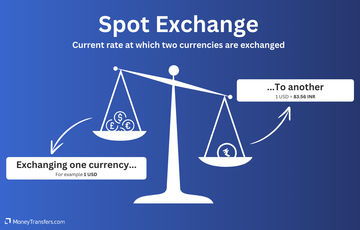
These allow an individual or firm to buy the required foreign currency at a so-called Spot Rate at the time of transaction.
This eradicates the time gap when agreeing on a price and making a payment.
For example
If you were located in the US and wanted to buy goods from a company in India using INR, you could simultaneously sign the contract and buy INR to pay the company in India.
This works even if the payment was not due for a few weeks, thus removing the risk of INR depreciating in the intervening period
This is what it would look like based on the example above.
| USD | INR Price |
|---|---|
| 10000 USD | 947033.50 |
| 20000 USD | 1894067.00 |
| 50000 USD | 4735167.50 |
| 100000 USD | 9470335.00 |
| 300000 USD | 28411005.00 |
| 500000 USD | 47351675.00 |
| 1000000 USD | 94703350.00 |
| INR | USD Price |
|---|---|
| 10000 INR | 105.59 |
| 20000 INR | 211.18 |
| 50000 INR | 527.95 |
| 100000 INR | 1055.90 |
| 300000 INR | 3167.70 |
| 500000 INR | 5279.50 |
| 1000000 INR | 10559.00 |
Hedge exchange
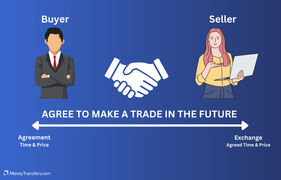
Hedge exchange is an agreement between two parties to make a foreign currency trade in the future, with the cost of that transaction being agreed beforehand.
The sole purpose of a hedge exchange is to protect a current position or upcoming international transaction.
When you consider that in the past decade, EUR/USD went from 1.32 EUR in 2013 per USD to 1.08 in 2023, it is clear that the fluctuations could cost you a lot of money.
One of the most common hedge exchange strategies is forward exchange contracts.
Foreign exchange contracts allow anyone to exchange currencies at a fixed price on a future date.
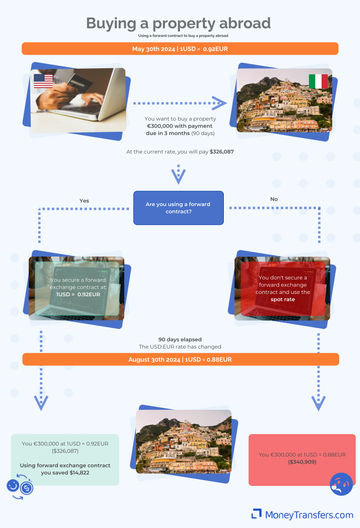
For example, let's say you're in the US and want to buy property in Italy.
Let's assume the property costs €300,000 and is due in 90 days and the exchange rate at the time is 1 USD to 0.92 EUR.
At the current rate, it would cost you $326,087 but you still have 3 months to save up and get everything in order. In 3 months, the rate changed and is now 1 USD to 0.88 EUR.
If you were using a spot rate (the live rate at the given time) you'd be spending $14,822 more than if you've used a forward contract.
Here's how it looks:
Currency swap
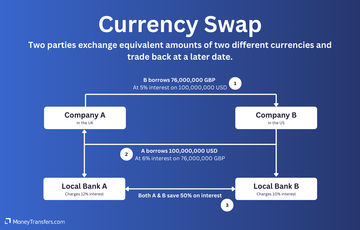
A currency swap is an interest rate derivative whereby two parties exchange the principal amount of a loan and the interest in one currency, for the principal and interest in another currency.
For example
If a British company needs EUR and a French company needs a similar amount of GBP, the British company could borrow GBP while the French company borrows EUR.
The companies will then swap the currencies, as per the prearranged terms, giving each company the foreign currency it needs while allowing each party to pay back the loan in its local currency, thus eliminating foreign exchange rate risk.
Money transfer brokers
Another way to mitigate foreign exchange risks is to use a specialized money transfer broker with experience in large transfers.
One of our recommended options for this is RegencyFX.
.svg)
Regency FX
RegencyFX is great for any type of large transfer, be it international mass payments or buying a property abroad.
With their experience in the market, they can assist you every step of the way, provide insights into taxes, set up forward contracts, and recommend strategies for mitigating exchange risks.
Please share your experience with Regency FX
Would you recommend Regency FX?
Anonymous
Say they will give you free quote, make it seem all they want is your email but then once you provide that they ask for everything else too
Elmo Saunders
Selling house in Okinawa, want to transfer from yen to USD when exchange rate is better than 120 to 1. Want to transfer from Okinawa bank account to Charles Schwab account in USA.
Anonymous
Comparison shows best outcome, but they want to give a quote via email or phone. Let's see...
Dominic Bolongaro
DO NOT USE THIS COMPANY! In particular do not use James Low. There are a number of 1 star reviews on here all saying the same thing. They provide a rate, when quoting for the transaction, which is in line with (or better than) other FX services. They then, once funds are received, give you a rate significantly lower than other FX services. In essence shaving off as much as they can get away with. In my case I refused to accept the initial rate and they readjusted twice before I was happy to proceed. Even then the rate I had to accept was a good few hundred pounds lower than other FX services. In my opinion they, and in particular James Low, are running a racket not a legitimate FX service.
Anonymous
It's a 10.
David Piper
Superb service, great rates
Simon Smith
Regency FX are great. Sending my earnings in Saudi home, and the guy that looks after me is brilliant
Claudio Velazquez palacios
Pay all transacción ok tank
Geoffrey Brooke
A very stressful experience. Their verbal quote was a lot higher than what they actually offered us once they had our money. On the Monday, Jamie at Regency FX verbally quoted us €1.1714/£, which was better than anyone else on the day. So we transferred our money to them, but by Thursday, he quoted us less than €1.14/£. The spot rate on Google had hardly changed and other FX companies were still quoting around €1.17/£. Fortunately, we were in no hurry to send the money so asked that they refund us if they couldn't get near €1.17. By Friday afternoon, Jamie quoted us €1.1647/£, which we reluctantly accepted (to reduce the hassle factor), which seemed to be about average when compared to other FX traders. Most of the initial reviews we had seen seemed quite positive, but when we looked further, we saw that there were others who had a similar experience.
Help & FAQ
Get answers to the most common questions asked when sending money abroad. Covers costs, fees and the best way to compare.
To recap: What are the FX risks?
Foreign exchange risk poses a very real threat to the value of international business transfers, as outlined in the scenarios on this page.
With our help, you can save yourself money and stress, by familiarising yourself with the possible outcomes and implementing the recommended tools detailed in this guide.
If you're looking to make a large transfer, be it for business or making a large purchase, a great way to start is by finding a reliable company to facilitate your transfer.
Use our form below to find the best money transfer operator for your needs.
Lock the exchange rates with top money transfer providers
Sources & further reading
Currency Forecasts
Currency transfer is the process of exchanging currencies for transfer purposes. Currencies are usually exchanged at an agreed rate of exchange for the currencies involved.
What is the Mid Market Rate?
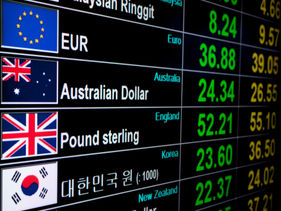
In other words, the mid-market exchange rate is the middle point between the price for buying and selling currencies at any given time and is therefore naturally set by the market as it fluctuates.
Forward Exchange Contract
Forward contracts are made between two parties without the need for another organization (such as an exchange or clearing house) to act as an intermediary.
How to Find the Best Exchange Rate
Finding the best exchange rate for your international money transfer is easier by doing the following:
Contributors

April Summers

Artiom Pucinskij

Please share your experience with …