
How to Send Money Without CVV in 2026
Table of contents



We only list companies that are trustworthy and appropriately licensed. Our aim is to give you a comprehensive view of the regulated money transfer marketplace.
DisclosureMoneyTransfers aims to help users find the best money transfer provider for their needs. To support our free service, we may earn a commission from some of the providers listed in our search results. The commission may also impact the ordering of the providers shown. Our reviews are independent from this and are based on our editorial policy, research and testing of dozens of remittance providers on the market.
Table of contents
You can make payments safely without a CVV by arranging bank transfers, using a P2P payment app, or even sending cash.
Your CVV is an important layer of security used when making online purchases or payments by card.
It helps verify you and confirm you're using your card, helping to prevent credit card fraud. However, you can make payments online without one.
Read on for more details on safely sending money without a CVV.
Search Now & Save On Your Transfer
Instantly view live exchange rates, fees & features.
CVV explained
A CVV (Card Verification Value) is a security code on the back of your debit or credit card that helps protect you from fraud.
It’s used to prove you have the debit or credit card you’re using and helps protect your account if your card number should fall into the wrong hands.
Your CVV is also known by other names, including:
Card Security Code (CSC)
Card Verification Code (CVC)
Card Validation Code 2 (CVC2)
Card Identification Number (CID)
What’s the difference between CVC1 and CVC2?
The CVC1 is the card validation code encoded on the card's magnetic stripe. This code is not visible and is unique to your card. The CVC2 is the same as the CVV; it’s the three-digit number printed on your card's back.
Where to find your CVV
Your CVV is printed on the back of your card.
It’s usually a three-digit number, but with American Express, it’s a four-digit number.
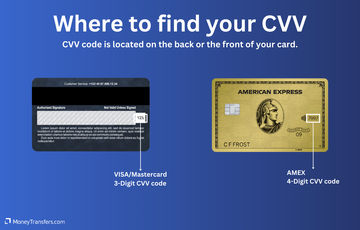
Each CVV is unique to the card and account holder and will change if you get a new card.
Your CVV is not your PIN
It’s important to note that a CVV is not your Personal Identification Number (PIN). You should never provide your PIN when paying for something online.
Sending money without CVV number
If you want to make an online payment with your card, you'll usually need your CVV to process the payment.
However, if you’re using a money transfer service, there may be some equally secure alternatives that you can use instead. These include:
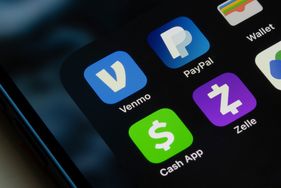
Using a peer-to-peer (P2P) payment service
Typically executed online through a money transfer provider website or mobile apps, peer-to-peer transactions facilitate the sending of funds from one person to another, via the internet or mobile network.

Making a bank transfer
Here’s a simple example, say you want to pay someone in the UK but you’re located in the US.


Sending cash
There are various ways in which you can send cash to someone including postal deliveries or giving the cash to someone who is traveling to the recipient’s location.

Using a P2P payment service
If you're making a purchase online, you could use peer-to-peer payment apps like PayPal.
To do this, you'll need to have a card or bank account linked to your PayPal account.
When you're first linking your card details to your PayPal account, you will need to provide:
Your CVV
Your 16-digit card number
The expiration date
Alternatively, you can link your bank account to your PayPal account, which will require your bank account number and branch/sort code.
Once you’ve linked these details, you won’t need to provide your CVV number for online transactions when using PayPal; these details will already be stored.
Many online retailers offer PayPal as a payment option, meaning you simply need your email and password to verify the purchase.
Just log in to your PayPal account and you won't need to enter your card details again into the retailer’s website.
Using a digital wallets
In addition to P2P payment apps, you can use digital wallets such as Apple Pay and Google Pay.
Both work similarly to PayPal where you link your bank card, input your details (including your CVV), and store it for future transactions.
Once you're ready to make a purchase, you'll be able to use Apple Pay or Google Pay (with face or fingerprint verification) to complete your transaction.
Sending money by bank transfer
Another alternative is to pay for your money transfer by bank transfer.
This way, the funds will be drawn directly from your bank account rather than your card.
You'll need to provide the following information to send money by bank transfer:
Your name
Your bank account number and sort code
The bank details of the account you want the money to be sent to and the name associated with this account
Sending money as cash
Another option is to send your money in cash. A few money transfer providers like Western Union and MoneyGram allow you to make transfers in cash.
Your recipient can then pick the cash up from a pickup point, collect it at their house (in the case of home delivery), or receive the funds directly into their bank account.
Of course, if you are looking to send money electronically, this isn’t going to be the best option for you.
Wise is a good option for sending money without CVV. You can either top up your balance via Apple Pay or Google Pay, or use your bank.
Both options don't require a CVV number.
Once your balance is topped up, you can use it to send money abroad or domestically.

"Over 15 million customers use Wise, mostly for their excellent mobile app, transparent fee structure & use of mid-market rates. Now increasingly used for larger transfers."
Please share your experience with Wise
Would you recommend Wise?
Russell Pinkes
I can’t send money to Belize
Katsiaryna
Once trying to open sire, was automatically blocked for no reason
Alan
Unable to transfer money from Philippines to any other country. Philippines Wise does not work
Anonymous
Retiro de dinero en transferencia
Uwe
great rates and service - unfortunately for some countries not yet available
Martin Premprakash Anantharaman
On the first transfer to a hospital in NY they were already screaming that this was a sure scam and the same on my next transfer to a fried in Nigeria. They then summarily closed my account TERMINATING THE RUNNING TRANSFER TO NIGERIA, claiming that, hold on, I was being scammed🤦♂️ Sure, I could have appealed but immediately found that I would have had to provide so much intrusive detail that I desisted.
Martin Premprakash Anantharaman
Setting up is a bit unwieldy if you want to make a one-off transfer, as you have to create an account with complete identification - but it works and the process as well as charges are great.
Anonymous
My brother wants to send me money from India to Nigeria but he's finding it difficult how can he do it
Mohammed
WARNING : Wise was Great until main office decided to ruin WISE By letting the TW India office control handling Random verifications and do what ever they want by insane replies and no replies etc. If you want to waste your time and enjoy a journey into Black Hole of Insane then go ahead and try WISE !
Anonymous
Can't receive money from php to idr so far
sudheir
They don't allow transfer to Brokerage firms from India
Anonymous
Good app to transfer money
Anonymous
I didn't find Cuba on your list.
Anonymous
cuba not work
Nina
I made a transfer to a Canadian company 1.5 months ago, and the funds have not yet been received. After multiple emails, Wise insists that the money was paid out. However, I have received an official statement from the recipient’s bank confirming that the money has not been received. Wise's complaints department sent me a final letter stating that, according to their records, the funds were paid out. Additionally, Wise states the following in their Customer Agreement regarding their responsibility for losses: Quote from Wise's Terms: "Our Customer Agreement also explains our responsibility for losses in Section 29: 29.1 Unforeseeable loss or damage. We are not responsible for any loss or damage that is not foreseeable. Loss or damage is foreseeable if either it is obvious that it will happen or if, at the time the contract was made, both we and you knew it might happen, for example, if you discussed it with us during your sign-up process. 29.9 We are not liable for things which are outside of our control. We (and our affiliates) cannot be liable for our inability to deliver or delay because of things which are outside our control." Despite these terms, Wise has not been able to resolve this issue, and the money has still not been delivered as promised. I find it irresponsible that Wise does not conduct any investigations into the matter. The Canadian bank associated with Wise is unable to provide any information, as everything goes through Wise. Wise must be capable of tracking the funds and providing precise details about where exactly the money is, who received it, and to which bank account it was deposited. I would advise everyone to be cautious when transferring large sums of money with Wise. They are not capable of executing a secure money transfer!
Shengjie Yin
good and perfect
Tristan
Beware: Wise's Unethical Policies and Unresponsive Support Cost My Business I am sharing my experience with Wise to warn fellow business owners about the serious risks and unacceptable practices you may encounter if you choose to use their services. My business, is a legally registered travel agency in the UK, and I relied on Wise to manage payments for my photography and cultural tours, primarily in South America. Things took a turn for the worse when Wise froze my account and accused my business of violating their Acceptable Use Policy, citing my once-a-year humanitarian trip to Cuba. Despite explaining multiple times that: No Cuba-related transactions were ever processed through Wise (I use a separate European bank for this purpose), My tours comply with the “Support for Cuban People” category authorized by OFAC, designed to help Cuban citizens outside state control, Wise completely ignored the facts. Their customer support team responded with automated messages, refused to engage in any meaningful dialogue, and even lied, claiming they didn't monitor my emails—despite clear evidence to the contrary. After days of chasing them and providing thorough documentation, they chose to close my account without justification. The Consequences: Wise left my business in chaos, disrupting essential transactions and client arrangements. Their rigid policies align with sanctions widely condemned by the global community, and in doing so, they indirectly support humanitarian suffering. The Bottom Line: Wise is unreliable, unresponsive, and unethical. If your business has any complexity or humanitarian focus, beware: Wise will shut you down without notice or explanation, and customer support will abandon you. Their actions have serious real-world consequences. Avoid Wise if you value your business stability or require ethical and accountable financial services. There are far better alternatives out there that won’t put your livelihood at risk Beware: Wise's Unethical Policies and Unresponsive Support Cost My Business
Anonymous
I have been a customer for a few years. Yes I love the instant deposits as I make around $1K. However as many non US entities Wise uses a bank out of New York. Therefore the TRANSFER and DEPOSIT from an account transfer can take 4 to 6 days. What this means is that you will not able to make another ACH transfer during this time. This is frustrating if you have to make a follow up transfer in a few days. All in all don't plan to make more than 4 transfer in a month because it may not fo through, Not sure if other transfer companies operate the same way but I am about to find out as I will try Revolute. Bottom linw will require you to use ANOTHER payment method like credit card or some other method. Understand this: YOU MAY HAVE THE MONEY IN YOUR ACCOUNT but they WILL NOT TRY TO VERIFY IT WITHIN THE THE PERIOD IT WILL TAKE THEM TO DEPOSIT IT IN YOUR ACCOUNT. To add insult to injury I called in and the agent siad that they can see that they got paid but the computer takes time to update/reconcille I guess! It is a slow system!
Anonymous
There is a lot of advice on RECEIVING INHERITANCE in the UK from overseas but nothing on the rules for SENDING money gifts to grandchildren living OVERSEAS and the rules on Inheritance Tax in that case.
Anonymous
The service is decent, nothing more. I have had security issues that are not quickly resolved. Call center personnel are average. The app is not, in general, user friendly. You should definitely do research on a variety of service providers before making a choice. Do not take the reviews at face value. I chose Wise based on positive reviews but now regret not doing more research on other companies.
Anonymous
So far so good
Daniel
I checked to see if Wise even sends money to Colombia. Colombia is not even in their list of countries. Why is it even advertising for Colombia?
Bill Sanders
I have used Wise for several years. They once rejected a large transfer because it was to a coal company. Apparently, they are a woke company! But they refused to tell me why. More recently, they required verification of my identity using a smart phone. I am 69 and never owned a cell phone because I don't need one. But they forced me to buy one, which I did last week. Getting the phone updates ate up all my data, so i got 1 GB more. I took 12 different pics of my passport and another 12 of my face for them. They rejected them - and are holding up my transfer. Now my phone ate up that gig of data and I must buy another gig (thru Tracfone) just to use the phone. What a hassle. This is not a photo studio! They know who i am already. Note: This comment has been edited by the MoneyTransfers.com team to align with our content guidelines.
Ziggy Meilus
It used to be always instant, now it may come right away or it can take 5 even 7 days to get the money.
Anonymous
i've heard of people having issues with accounts being locked/restricted, but i think that was mostly for business accounts, maybe they were locked for good reason. for me, i've had no issue with my account though i've only used it for small transfers and not very often, over the past 5+ years
How a CVV protects your account
A CVV is an extra layer of security that increases the likelihood that it’s you making the payment.
Requesting a CVV makes it harder for fraudsters to authorize payments with your card details if they don’t have the physical card with them.
Key benefits of using a CVV code when sending money
There are some key benefits to using a CVV code when making an online purchase. These include:

Protection against fraud
If someone gains access to your card details, they won’t be able to make a payment without your CVV.
Merchant’s can’t reuse CVVs
When you’ve purchased with a merchant, they may allow you to store your card details with them online.
Merchants are not allowed to store your CVV.
This helps stop you from overspending accidentally and prevents merchants from using your card without your authorization.
Services and stores that don’t need a CVV
As it’s only an optional additional security measure, not all need you to provide a CVV to buy something.
Some well-known names that don’t need a CVV include:

Amazon
Your card information is stored directly on Amazon account. You won't need to enter the CVV unless you're adding another payment method.
Walmart
Similarly, Walmart will store your bank details and let you re-use them on the next purchase.

Target
Target will store the CVV with no access to it. This will let you check out faster and won't require any details.
Apple Pay
You add your card to the Apple Pay along with your CVV. This information is stored for faster checkout at any store accepting it.
Google Wallet
Similarly, Google Wallet is connected to your bank account along with your CVV. The information is encrypted and allows you to pay directly from your card without needing the CVV code.
PayPal
When setting up PayPal, you enter your bank card details into the account. These are saved for future transactions.
When you're ready to pay, all you need is your PayPal account details and that's it.
Stores like these allow you to transfer money over using only your card number, and not your CVV.
Why some stores don't need a CVV for card payments
Most stores that don’t need you to provide a CVV when you make a card payment have other layers of security in place. These may include:
Address Verification System (AVS)
This cross-references your address and compares it to the address on file for the card.
Bank confirmation
The store may send you to your banking app so you can verify your payment remotely.
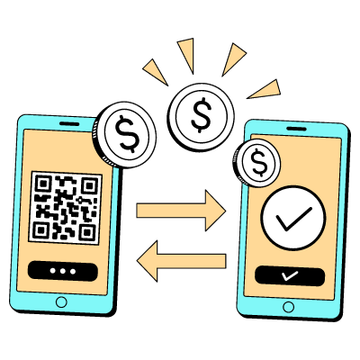
External payment apps
External payment apps like PayPal, Google Pay, and Apple Pay have your card details stored on file.
To verify your payment, you just need to log in to your account; you don’t need to enter your CVV again.
You may also find that some larger retailers simply have a higher risk tolerance than others.
They could potentially be prepared to absorb the costs of potential fraud and chargebacks, but this does not make it safer for you.
If you’re paying by card, entering your CVV helps protect you from potential fraudsters.
Be careful where you input your details
Make sure the store page you’re on is legitimate and respectable before entering your card details. Scammers sometimes create fake shopping sites to capture your payment details.
Find out more about online shopping scams, phishing scams, and other common money transfer scams on our scams page.
A bit more on CVVs
How do thieves use stolen debit cards?
Thieves can make payments using stolen debit cards, so if you suspect your card has been stolen, you must contact your bank immediately. They’ll be able to cancel your card. However, if only your 16 digit card number has been stolen, it’s more difficult for thieves to authorize payments from your account, as they’ll often need the CVV too.
Do credit card thieves get caught?
Unfortunately, a lot of credit card fraud goes undetected. The exact amount is impossible to know. The best way to fight credit card fraud is to prevent it from happening in the first place, which is why extra layers of protection like CVV confirmation are so important.
Is it safe to give PayPal my CVV?
Yes, PayPal is a very secure app that’s well-respected worldwide. However, you should only confirm your CVV through the official PayPal card verification process. Never enter your CVV in unauthorized places.
Can someone use my debit or credit card without the CVV?
People can only use your debit card without the CVV at stores that don’t require it.
How can I transfer money from my credit card without a CVV code?
A simple answer, you can't send money directly from your credit card without using CVV.
This is because anywhere you input your credit card details directly, will require you to add the CVV code for your security.
On a side note, we don't recommend using credit cards to transfer money, because it isn't widely available and come with hefty fees.
Instead, we suggest you with another alternative deposit method of your choice.
Help & FAQ
Get answers to the most common questions asked when sending money abroad. Covers costs, fees and the best way to compare.
Let's recap: CVVs - an extra layer of protection for your card payments
CVVs are an important layer of security. They help verify your identity when making payments online, adding another layer of protection should your card details fall into the wrong hands.
This is why your CVV is often an essential requirement when making an online payment and sending money.
For international money transfers, the best way to avoid using your CVV is to send money via a bank transfer with a money transfer provider (this means you won’t need to provide your card details).
Get started by finding a money transfer provider that suits your needs using the form below.
Send money without providing your bank details
Sources & further reading

The Best International Money Transfer Companies
Using your bank for international wire transfers is expensive due to poor exchange rates and high fees.

Best Money Transfer Apps in India
Below, I’ll go over these in a bit more detail.

Transfer Money From Overseas to Australia: Tax Implications
In general, if you receive any income from abroad while in Australia and fall within the AU tax brackets, you will need to pay tax.
Sending Money Abroad
Ideal for sending money internationally, money transfer services have made huge strides in the past couple of decades to make sending your money abroad cheaper, faster, and easier than ever.
Send money with a debit card
Opting to send money online with a debit card is usually good for:
Contributors

Yasmin Purnell

Artiom Pucinskij

Please share your experience with …