
International Money Orders
Table of Contents



We only list companies that are trustworthy and appropriately licensed. Our aim is to give you a comprehensive view of the regulated money transfer marketplace.
DisclosureMoneyTransfers aims to help users find the best money transfer provider for their needs. To support our free service, we may earn a commission from some of the providers listed in our search results. The commission may also impact the ordering of the providers shown. Our reviews are independent from this and are based on our editorial policy, research and testing of dozens of remittance providers on the market.
Table of Contents
International money orders are a way to send money to someone in another country.
You buy a money order at a post office or bank, pay a fee, and send it to the recipient. The recipient can then cash it or deposit it into their account.
It's a great and secure alternative when wire transfers or online providers are not available.
Here we'll look at what money order is, how it works, and when you should use it. We'll also explain the costs, safety, and speed and answer all pressing questions.
Search Now & Save On Your Transfer
Instantly view live exchange rates, fees & features.
International money orders offer a secure way to send small amounts of money internationally. Available from banks, post offices, and transfer services, they involve prepaid funds that the recipient can cash or deposit. While safe and convenient, they can have higher fees and slower delivery compared to money transfer companies.
What is an international money order?
An international money order is a document that works as a safe and secure way of sending small amounts of money overseas.
Fun fact, money orders were established in the UK in 1972 and were known as postal orders.
How do international money orders work?
International money orders work similarly to checks, but you won’t need a bank account to receive the money.
The sender pre-pays an amount and the document is sent to the recipient, who can exchange it for cash or deposit it to their bank account.
Who offers international money orders?

Post office
Pretty much every major postal service or post office will offer a money order.

Banks
Similarly, most banks offer postal order services.

Money transfer providers
Online services such as Western Union or MoneyGram also offer the option to send international money orders.
Buying international money orders
You should be able to purchase an international money order from your local postal service, a range of banking institutions, and some money transfer providers.
🇺🇸 International money order in the US
If you’re in the US you should be able to purchase an international money order from the USPS to a range of countries.
Your transfer limit is generally around $700, but it will depend on where and how you send the money.
However in the US, you won’t be able to send money via an international money order to certain countries - instead, you’ll need to use a service called ‘Sure Money’ or ‘DineroSeguro’.
Aside from the USPS, you can also buy an international money order from various banks or even your local Walmart.
🇨🇦 International money order in Canada
To get an international money order in Canada you’ll need to go to the relevant institution or organisation.
They will take the required information and fill the form out for you.
Canada’s postal service is called Canada Post.
🇬🇧 International money order in the UK
To get an international money order in the UK you can purchase a money order from from the Post Office or some banks.
Are internatinoal money orders safe?
International money orders are completely safe and private, with no risk of losing money if the order is misplaced or stolen as it needs to be signed by the named recipient to be cashed.
Sending international postal orders
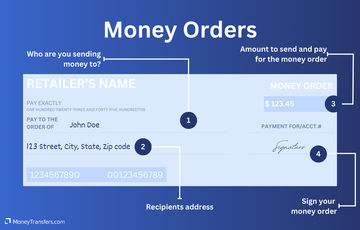
Sending an international money order is relatively straightforward - just follow these steps:

Buy a money-order certificate
Buy a money-order certificate from a third-party provider, such as your local postal service (Post Office, USPS, etc), bank, or money transfer branch.
You’ll normally be able to pay using cash or a card.

Fill out the money order form
Fill out the money order form with the required information, including your name, address, and contact details, the recipient’s name, and the sum of money you’re sending.

Send it
Send your international money order certificate to your recipient, usually via international mail
Cashing an international money order
When you receive an international money order, you’ll be able to cash it at a local bank, post office, or even some shops. You will need to:
Sign it
Sign the money order just before you give it to the cashier so they can see you do it
Show your ID
Provide identification, usually either a passport or driving license
Pay the fee
Pay any required fees as part of the transaction

Confirm the amount
Ensure the amount of money is correct before leaving the location
How fast can you cash an international money order?
It depends on the specific country and financial institution.
It could take anywhere from a few days to several weeks.
In some cases, the recipient may also need to go through a verification process before they can receive the funds.
To ensure faster processing, it is best to consult with both the issuing and receiving financial institutions beforehand.
The cost of international money orders
International money orders vary in price and generally cost upwards of $10. Here's a quick roundup of the starting fees based on the biggest money order services:
UK Post Office: capped at £12.50
USPS: set at $10.25
Sure Money: purchases lower than $750 will cost $14.55
Sure Money: purchases between $750 and $1,500 will cost $20.75
However, these are not all. Total costs are usually associated with the processing fee and the currency exchange rate.
Practical example with USPS
For example, an international money order from USPS will include an issuing fee of $49.65 and the processing fee based on country.
There is a limit of $700 for international money orders if using this route, but you can purchase several money orders of $700 denomination if you intend to send a higher amount.
This means that, for instance, sending money orders worth $7000 through USPS would cost more than $100 in fees.
Another cost associated with international money transfers is the currency conversion fee when the recipient cashes the money order or deposits it in their local account.
Again, the exchange rate margin will vary on a variety of factors including:
The provider you use
The country you’re sending to
The currencies involved
However, it is typical to see margins associated with international money orders being higher than with online transfers.



International money order transfer limits
You will likely find that international money orders come with limits for how much you can send abroad, depending on the provider you use and the country you send to.
However, the average value of a postal order in the US is around $315 which is about $78 million moved around the US per day.
For example, USPS has a maximum limit of $700 per international money order and allows the sending of multiple money orders up to a maximum limit of $10000.
Generally, most providers would have a limit of around $1000 per money order, meaning that if you are planning to send large amounts overseas, international money orders might not be your best option.
The speed of money orders
The total time an international money order takes can vary from a few days to a few weeks long depending on where the mail is being sent.
This means it is rarely the fastest option for transferring money, and this is because there are a variety of steps involved.
Normally, it takes no more than a few minutes for you to get your money order made.
Once you fill up the form and pay for the money order, the issuer will take only a few minutes to process the request and provide you with the money order.
However, once you have made and paid for your order, it will then take more time to be physically sent to your recipient before they can get it paid out.
To ensure faster processing, it is best to consult with both the issuing and receiving financial institutions beforehand.
Benefits and drawbacks of using money orders
- Convenience: Sending an international money order can be a convenient option, as you can pay via cash, card or even traveller’s cheques, and you don’t need a bank account to send or receive funds
- Safety: It’s a safer method than sending cash as even if the money transfer order is stolen in transit it can’t be used by anyone but the named recipient - and a signature is required by both sides
- Prepaid guarantee: As the transfer is already prepaid by the sender there is no chance the money order will bounce
- Trackable: International money ordered are often trackable, which means you’ll be able to see how far along your order is and when it’s been collected
- Good alternative: Money orders are a good alternative for when you cant wire money through your bank or money transfer service.
- Send and receive fees are expensive: International money orders can be quite costly when it comes to fees, compared to other methods of sending money
- Low limits: International money orders can sometimes come with limits to how much you can send, so they aren’t always a great way of sending large amounts overseas
- Poor exchange rates: You may not get the best currency exchange rates with international money orders, which affects how much you’ll be able to send
- Slow as sent via post: While they are safe and reliable, international money ordered can take a while as they are usually sent via the mail
- Not accepted everywhere: Some places don’t accept international money ordered, while some providers only let you send money ordered domestically
Best alternatives for international money orders
International money orders have their upsides and their downsides, but it’s up to you to decide whether it’s the best way to send money abroad.
You may want to consider the following alternatives:
Money transfer operators
Using a money transfer operator is the quickest, easiest, and often the cheapest way to send money abroad.
You can use a money transfer operator to send funds via bank transfers, money pickups and deliveries, and mobile wallet apps.
Wire transfer
Sending money via a wire transfer can be a useful method if you and the recipient use the same bank, but otherwise, there can be significant fees and longer waiting times.
Find a better alternative to postal orders
A bit more on money orders
Can I cancel an international money order?
You may be able to cancel an international money order if it has not been cashed.
What is the difference between a money order and a money transfer?
A money order is a physical, paper form of payment that can be purchased at certain retailers, post offices, and financial institutions.
It is similar to a check but generally has a lower limit on the amount that can be sent.
A money transfer, on the other hand, is an electronic transfer of funds from one bank account to another.
Can you send money orders online?
In some cases, it is possible to send a money order online.
However, it depends on the specific company or institution that you are using to send the money order.
Some companies offer the option to send an electronic money order, while others may only offer the traditional paper version.
It is important to research and confirm with your chosen company before attempting to send a money order online.
Additionally, it is important to note that there may be additional fees associated with sending an electronic money order.
It is always a good idea to carefully review the terms and conditions before proceeding with any type of online transaction.
How do you check if a money order has been cashed?
To check if a money order has been cashed, you can:
Contact the issuer of the money order and provide your money order number - they should be able to tell you if it has been cashed or not.
You can also try to track the money order through a tracking service, if available.
Additionally, if you have a receipt of the money order, you can often check its status online or by phone.
It is important to keep track of your money orders and contact the issuer immediately if it is lost or stolen to ensure it does not get cashed by someone else.
Help & FAQ
Get answers to the most common questions asked when sending money abroad. Covers costs, fees and the best way to compare.
Let's recap: What are money orders?
If you want a guaranteed prepaid way of delivering money overseas, then international money orders might be for you, but by looking into the various online money transfer providers around today, you will probably be able to find a quicker and cheaper way to transfer your funds abroad.
Find a better alternative to money orders
Resources & further reading

How to Send Cash Abroad
There are various ways in which you can send cash to someone including postal deliveries or giving the cash to someone who is traveling to the recipient’s location.
How to Send Airtime: Top Options, Ranked for 2026
Airtime is a popular form of credit used to top up prepaid mobile phones. It can be used to access all the offerings of your network’s service, such as making or receiving calls, text messages, and using mobile data.
How to Send Money With a Credit Card: All Your Options Compared
Yes, you can send money online using your credit card, however there may be some limitations. If you’re using a money transfer provider, remember not all providers accept credit card payments.
Different Ways to Send Money to a Bank Account in 2026
Most bank transfers can be made online. If you prefer, you may be able to start a transfer in person at your local branch, or over the phone. You can transfer money to a bank account via:

How to send money to someone without a bank account
Millions of migrants around the world send money to predominately unbanked populations such as India, China, and the Philippines.
Contributors

Mehdi Punjwani

Artiom Pucinskij

Please share your experience with …