
International Transfer Limit: How Much Can You Send Abroad Without Tax?
Table of contents

Author: Artiom Pucinskij
We only list companies that are trustworthy and appropriately licensed. Our aim is to give you a comprehensive view of the regulated money transfer marketplace.
DisclosureMoneyTransfers aims to help users find the best money transfer provider for their needs. To support our free service, we may earn a commission from some of the providers listed in our search results. The commission may also impact the ordering of the providers shown. Our reviews are independent from this and are based on our editorial policy, research and testing of dozens of remittance providers on the market.
Table of contents
There are often different limits on how much money you can send abroad.
These may depend on the country you’re sending money to, the country you’re sending funds from, and the method of your transfer.
Here, we'll over the transfer limits in the US for IRS purposes. We'll also look at what is involved in international money transfers, as well as limits in other countries.
Search Now & Save On Your Transfer
Instantly view live exchange rates, fees & features.
Is there a limit to international money transfers?
There’s no official limit on how much money you can send to another country.
However, individual restrictions can apply to specific countries and payment methods, as well as some limits applied by certain banks and money transfer providers.
It’s worth noting that financial institutions and money transfer providers are required to report international transfers that exceed $10,000.
Transfer limits with money transfer services
Here are the transfer limits for some of the best money transfer companies available.
Provider | Transfer fee | Limit |
|---|---|---|
From 0.41% | Up to $1m per local transfer, up to $1.6m per SWIFT transfer, and up to $6m if added to Wise balance | |
$3 in US for small transfers. | $535,000 or sending currency equivalent | |
From £/$0.99 - £/$3.99 depending on currencies | $9,000 per 24hrs, $5,000 per transfer, or $300 per Apple Pay transfer | |
No fees with this provider, the fees are in the exchange rate which typically range from 1 - 2% above the mid-market rate | No limit. | |
From $0 - $35 depending on currency pair and payment method | ACH: $3,000*. Set up Instarem as ‘Payee’: No sending limit. International wire transfer: No sending limit. Debit/Credit card: $2,500* |
Why do some money transfer providers set their own spending limits?
Some providers set transfer limits to protect against possible money laundering. Others limit the amount that can be transferred to specific countries due to regulatory or reporting requirements.
What about bank limits?
Banks will often set their money transfer limits. We’ve summarized some of the main branches here.
Bank | Maximum amount | Notes |
|---|---|---|
Chase | $ 25,000 for standard account holders $100,000 for Sapphire and Private Client account holders | Business accounts have a maximum of $250,000 |
ING Bank | $100,000 for SEPA instant payments$ 25,000 for HomeBank customers | BusinessBank customers have a maximum of $125,000 |
Bank of America | $1,000 (Wire transfer only) | $5,000 for business account holders |
Capital One | No limit | Can only be completed in-branch |
Reporting international money transfers to the IRS
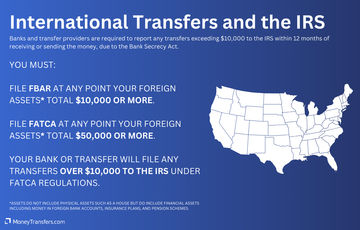
Banks and transfer providers are required to report any transfers exceeding $10,000 to the IRS within 12 months of receiving or sending the money, due to the Bank Secrecy Act.
Reporting requirements for money held in foreign accounts
If you have money in foreign accounts:
You must file a Foreign Bank Account Report (FBAR) with the US Treasury Department if, at any point, your foreign assets* total $10,000 or more.
You must file a Foreign Account Tax Compliance Act (FATCA) form with the IRS if, at any point, your foreign assets* total $50,000 or more.
Your bank or transfer provider will need to report any transfers over $10,000 to the IRS under FATCA regulations.
*Assets do not include physical assets such as a house but do include financial assets including money in foreign bank accounts, insurance plans, and pension schemes.
These regulations also mean banks and financial institutions must report any other kind of suspicious activity to protect consumers and prevent money laundering.
This includes multiple smaller transactions that may be sent to evade the $10,000 rule, such as multiple transactions of $8,000 sent in quick succession.
This doesn’t mean you can’t send amounts over these thresholds, but you’ll need to file some paperwork if your total overseas assets exceed the thresholds.
What are the penalties for non-compliance with the Bank Secrecy Act?
As the BSA is in place to prevent money laundering, deliberate avoidance of or non-compliance with its regulations can result in a hefty fine and even a custodial sentence.
Any person, including a bank employee, violating the BSA is subject to a criminal fine of up to $250,000 five years in prison, or both.
Banks are also subject to heavy penalties for non-compliance with the BSA.
A bank that violates certain BSA provisions faces criminal financial penalties of up to $1 million or twice the value of the offending transaction, whichever is greater.
Consider international sanctions
Some countries may implement economic sanctions against another country for geopolitical reasons.
These may include attempting to prevent terrorism and terrorist financing, drug trafficking, human rights violations, and/or illegal military action or weapon supplies.
Sanctions can target an entire country, or they can be more narrowly targeted at individuals or groups.
Sending money or making money available to sanctioned countries or individuals is illegal under the Countering America’s Adversaries Through Sanctions Act (CAATSA).
This applies even if you do not make funds directly available to the sanctioned entity, but could reasonably assume the finances sent may be sent to a sanctioned entity.
Paying taxes to the IRS on money transfers
Most international money transfers in and of themselves are tax-free.
However, it depends on the circumstances of your transfer, such as the source country, the recipient country, and the amount you’re sending.
Let's take a look at a few common examples of hen you might and might not need to pay tax on money transfers.
Paying tax on the money I’m transferring to my accounts
Money transferred to one of your accounts is not taxable, as you’re essentially just moving your money rather than earning more.
However, if your overseas assets total more than $10,000, you’ll need to report this to the US treasury as a Foreign Bank and Financial Accounts Report (FBAR).
If they total more than $50,000, you’ll also need to file a Foreign Account Tax Compliance Act (FATCA) report with the IRS.
This does not necessarily mean you will be liable for tax.
Paying tax on the gifts to other people
US citizens have an annual tax-exempt allowance on gifts to people, which applies both in the US and overseas.
For the 2024 tax year, this stands at $18,000, or $36,000 for married couples.
If the transferred sum exceeds this threshold, you can offset the remaining amount using the lifetime gift tax exemption, set at $13.61m for 2024.
For example, if you’re single and you gifted $20,000 to somebody else, $18,000 would be tax-free under the annual gift tax exemption.
The remaining $3,000 would need to be deducted from your lifetime gift tax exemption amount of $13.61m. This would leave you with a remaining lifetime gift tax exemption amount of $13.61m.
It’s worth noting that the lifetime gift tax exemption also applies to amounts left to beneficiaries in their inheritance after you die.
This exemption is being steadily reduced and is due to be capped at $6m by 2026.
Are any gifts exempt from taxes?
Certain gifts are not considered taxable. These include:
Gifts to charities approved by the IRS
A gift to a spouse, if they’re a US citizen
A gift to cover someone’s education tuition, if paid directly to the educational institution (this does not cover room and board, books, or supplies)
Gifts to cover someone’s medical expenses, if paid directly to the medical facility
A gift to a political organization
For more information about the tax implications of your money transfer, see our guide on money transfer taxation.
Need to send large amount of money abroad?
There are lots of ways to send large amounts of money internationally, but the easiest and cheapest way is usually via a specialist money transfer broker. Specialized broker services can help you with taxes and provide guidance on the best course of action.Money transfer limits in certain countries
Some countries set their limits on international transfers, usually to prevent money laundering.
If you’d like to transfer money to these countries, you’ll need to make sure you comply with these rules.

Philippines
The central bank of the Philippines, Bangko Sentral ng Pilipinas (BSP), states you can transfer up to ₱50,000 (PHP) to the Philippines without needing prior written authorization from the BSP.
For foreign currencies, the limit is $10,000 (USD) or equivalent in another foreign currency.

India
There aren’t any hard limits on how much money you can transfer to India, so the standard reporting and taxation rules apply.
However, your chosen bank or transfer provider may impose their own transfer limits.

Mexico
There aren’t any hard limits on how much money you can transfer to Mexico, so the standard reporting and taxation rules apply.
However, your chosen bank or transfer provider may impose their transfer limits.

Canada
There aren’t any hard limits on how much money you can transfer to Canada, so the standard reporting and taxation rules apply.
However, your chosen bank or money transfer service may impose its own transfer limits.
Compare rates and get the best deal
Find the best rates for transferring to Canada, the Philippines, and the rest of the worldA bit more on money transfer limits
What’s the international money transfer limit set by the IRS?
The IRS doesn’t set a universal limit on international money transfers, but any transfers over $10,000 will need to be declared by your bank or transfer provider.
Banks and transfer providers are also required to declare any suspicious activity, such as regular payments of large amounts under $10,000, to help prevent money laundering.
What’s the international limit on wire transfers?
There’s no overarching legal limit on international wire transfers, but some banks, transfer providers, and countries may set their limits.
Do I have to pay tax on international money transfers?
Transferring money to one of your accounts doesn’t incur any taxes, as you’re essentially just moving money you already have, rather than earning more.
Gifts to others are taxable above your annual gift tax exemption amount of $18,000 for 2024, but amounts above this can be offset against your lifetime gift tax exemption if you wish.
What happens if you wire transfer more than $10,000?
If you wire transfer more than $10,000, your bank or transfer provider will need to report this transfer to the IRS in line with the Bank Secrecy Act.
This is to make sure the IRS is aware of any potentially suspicious transactions to prevent money laundering.
Can I transfer $100,000 from one bank account to another?
You can send more than $100,000 from one bank to another, but some banks and transfer providers will have a limit on how much money you can transfer at one time, which may be below this amount.
To send $100,000 from one account to another, you can initiate a wire transfer, provided it's within the transfer limits set by your bank.
Alternatively, you can arrange multiple transfers of smaller amounts until you have sent $100,000 in total.
Remember, all transfers over $10,000 will automatically be reported to the IRS.
Help & FAQ
Get answers to the most common questions asked when sending money abroad. Covers costs, fees and the best way to compare.
Sources & further reading

The Best International Money Transfer Companies
Using your bank for international wire transfers is expensive due to poor exchange rates and high fees.

Best Money Transfer Apps in India
Below, I’ll go over these in a bit more detail.

Transfer Money From Overseas to Australia: Tax Implications
In general, if you receive any income from abroad while in Australia and fall within the AU tax brackets, you will need to pay tax.
Sending Money Abroad
Ideal for sending money internationally, money transfer services have made huge strides in the past couple of decades to make sending your money abroad cheaper, faster, and easier than ever.

Send money with a debit card
Opting to send money online with a debit card is usually good for:
Contributors

Please share your experience with …